UAE Adviser Says Military Fixes Rarely Solve Gulf Crises
Officials at the Manama Dialogue discuss Qatar-led mediation efforts and the financial costs of recent regional conflicts.
By Lucas Collins ·
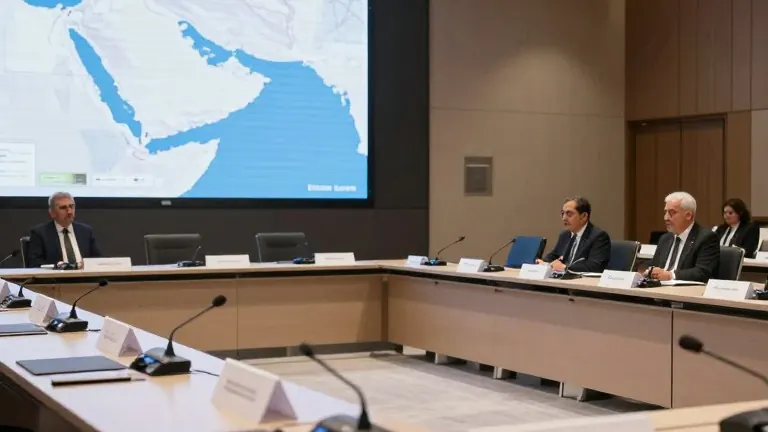
UAE presidential adviser Anwar Gargash stated on Sunday that diplomatic breakthroughs remain the preferred path to ending the current standoff between Washington and Tehran.
Speaking at the Manama Dialogue security forum in Bahrain, Gargash argued that military solutions rarely provide quick exits from complex regional disputes. He noted that the war, which began on February 28 with joint strikes by the United States and Israel, has become a defining period for the area. Gargash told the audience that his country hopes to avoid another round of direct confrontation.
Iranian Foreign Minister Abbas Araghchi confirmed that Iranian negotiators are currently in Qatar working on a proposal to reopen the Strait of Hormuz. Araghchi said no direct talks are occurring with the United States, but the final outcome depends on how Washington answers specific questions from Tehran. He added that Iran prefers diplomacy but remains ready for defense depending on American rationality.
The financial and physical toll of the conflict has reshaped regional defense spending. Before the April ceasefire, the United Arab Emirates faced more than 3,000 drone and ballistic missile attacks targeting airports, military bases, and oil facilities. Most of these projectiles were intercepted, but Gulf nations have since spent billions of dollars to upgrade their defense capabilities to handle future threats.
Bahraini officials highlighted the specific strain on their infrastructure during the peak of the fighting. According to the International Institute for Strategic Studies, Iran fired 500 drones and nearly 200 ballistic missiles at Bahrain. These strikes hit the U.S. Navy’s 5th Fleet base, residential areas, the financial district, and a water desalination plant. Bahraini Foreign Minister Abdullatif bin Rashid Al Zayani said his country welcomes all efforts to reduce tensions and create dialogue opportunities.
Al Zayani described a consistent pattern of Iranian attacks on sea, air, and data facilities that continues even after the ceasefire. He pointed to threats against underwater data cables and recent Houthi attacks on Saudi Arabia as evidence of this ongoing strategy. He stated that while the actors may change, the approach to disrupting regional stability remains the same.
Gargash acknowledged that the stances of the United States and Iran are currently far apart. He warned that if these positions are not bridged, the region must prepare for the worst-case scenarios. He emphasized that it is not in the interest of the region or Iran to withstand another round of war, a sentiment shared by other Arab officials at the forum.
Egyptian Foreign Minister Badr Abdelatty told the gathering on Saturday that a second round of escalation would be more destructive and lead to nowhere. Gargash noted that the conflict has solidified U.S.-UAE relations, making the partnership central to the UAE’s ability to defend itself.
A major issue discussed at the forum was the lack of a coordinated defense response among the six members of the Gulf Cooperation Council. During the war, countries like the UAE and Bahrain operated primarily at the national level, working with U.S. command centers rather than through a unified regional command. Gargash offered a candid assessment of this structure, stating that while each state rose to the challenge independently, the group as a whole has not yet managed to do so collectively.
Source: ABC News
More Business · Consumer Watch · Report a business · Got a Story?