Harvard analysis caps lunar city size at 10,000 residents
Water reserves on the moon likely support small settlements for centuries, but not the million-person metropolises promised by space industry leaders.
By Emmanuel Obasi ·
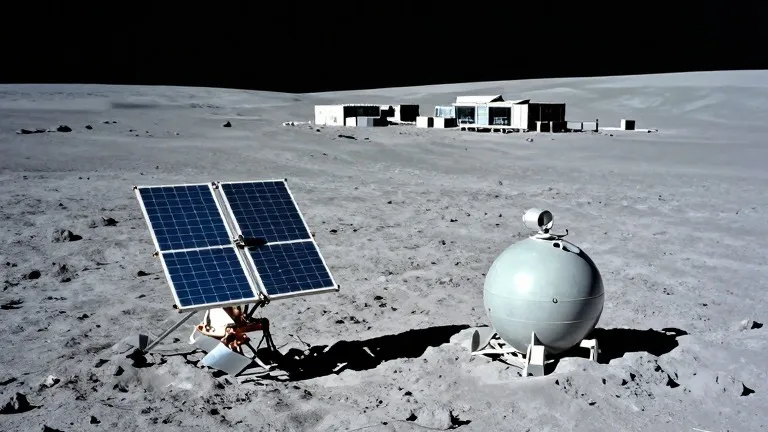
Space industry leaders have pitched lunar cities capable of holding millions of people, but a new analysis suggests the moon's water supply can only sustain towns of about 10,000 residents for centuries. The findings challenge the timeline and scale of current commercial ambitions for lunar settlement.
The study, published in Frontiers in Space Technologies, evaluates the two essential resources for lunar life: power and water. Researchers Martin Elvis of the Smithsonian Astrophysical Observatory and Jonathan McDowell of Durham University found that power is not the limiting factor. Solar and nuclear energy sources would be sufficient to support a population of one million.
Water presents a tighter constraint. Estimates place the total lunar water supply at roughly one billion tonnes, mostly located in permanently shadowed polar regions. Under the assumption that 98 per cent of water can be recycled, a million-person settlement would exhaust these reserves in approximately 100 years. By contrast, a community of 10,000 people could remain sustainable for centuries.
The baseline estimate of one billion tonnes may be optimistic. Elvis noted that the actual recoverable amount could be 20 to 30 times smaller than current satellite data suggests. He estimated that only one per cent of the water may be practically accessible, which would reduce the 100-year lifespan for a million residents to just one year.
The physical form of the water adds further complexity. Gordon Osinski, a planetary geology professor at Western University, described the water as potentially resembling Arctic permafrost. In this state, sub-millimetre ice crystals are mixed into soil, making extraction difficult. He emphasized the need for on-ground confirmation of satellite measurements.
These calculations come as high-profile executives promote aggressive timelines for space colonization. Elon Musk stated in February that SpaceX aims to build a self-growing city on the moon in under 10 years. Jeff Bezos has claimed millions of people will live in space by 2045. The new data suggests that while lunar habitation is feasible, the scale must remain modest unless new water sources are discovered.
McDowell cautioned that the limits on water do not negate the value of exploration. He stated that the goal is to act on verified data rather than untested assumptions, noting that attempting projects without proper resource planning is the true risk.
Source: CBC News
More Business · World news · Consumer Watch · Report a business · Got a Story?