Wyoming Woman Plans Winter River Plunge
A Lander resident aims to complete her first full season of cold water exposure, citing discipline and physiological benefits.
By Lucas Collins ·
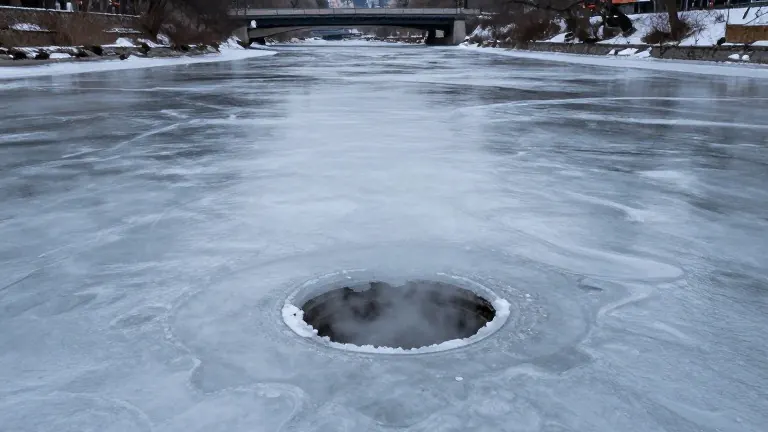
Winter in Wyoming often brings temperatures that keep most residents indoors, but one local woman is preparing for the opposite. Felicity Hnilicka, 24, intends to jump into the Popo Agie River every month from November through March, a routine she has attempted for three years without finishing a single full season.
Hnilicka has spent the last three winters dunking herself in icy streams, usually alone. She began the practice in February 2024, when the air temperature hovered around 16 degrees. On that morning, she and friends jumped into the river before a skiing trip. Their wet feet stuck to the rocks upon exiting the water, yet Hnilicka described the experience as enjoyable. She now plans to stay in the water for five to 10 minutes as the season progresses, though she caps her exposure at that duration.
The practice serves a purpose beyond physical endurance for Hnilicka. A former personal trainer, she believes overcoming the initial resistance to entering cold water builds mental discipline. She said that forcing herself to act when her body resists has helped reduce procrastination in daily tasks, such as answering emails. "If I can just say, 'You gotta go, you gotta do it,' then it's also helped translate into not procrastinating my life events," she said.
Hnilicka is recruiting other Lander residents to join her at the City Park bridge near McManus. She generally begins her dives in November, keeping her time in the water brief during the first two weeks. Her car remains running with a warm towel and hot tea ready for after each plunge. She notes that her skin turns red and her heart races, but after a few weeks of practice, she can better control her breathing. "It is a rush," she said. "I just feel excited and relaxed at the same time."
Kimberly Coats, who lives on a 600-acre ranch near Savery, shares this perspective. Coats and her husband, a former professional athlete, chopped a hole in the ice of Savery Creek during a winter when the water was 32 degrees and the air was 20 degrees. They entered the water in their robes. Coats described the initial shock as overwhelming, followed by a tingling sensation that made her feel incredibly awake. "It was almost like this manufactured high," she said. Her husband and Coats always entered the water together to ensure safety, as passing out under the ice could prove fatal. A doctor later advised Coats to stop the practice due to an unrelated medical diagnosis, but she still finds Wyoming winters invigorating.
Ward Dobbs, an assistant professor of kinesiology and health at the University of Wyoming, explains the physiological mechanics behind the practice. When a person enters icy water, the body triggers a powerful stress response that accelerates heart rate and breathing. However, submerging the face in cold water triggers a separate reflex that slows the heart. This creates a state Dobbs calls cardiovascular conflict. For healthy individuals, the body can tolerate this stress, but those with underlying heart conditions face higher risks. Repeated exposure allows the body to adapt, similar to acclimatizing to heat. "In theory, I mean it's similar to heat stress, cold stress, any type of stress, or even exercise," Dobbs said.
Flowing water presents different risks than still water. In a river, moving water constantly strips away the thin layer of warmed air and water surrounding the skin, increasing heat loss through convection. Dobbs noted that cold exposure can impair muscle function and coordination, potentially making it difficult for even trained swimmers to exit the water. Wind, current, and post-plunge warming all influence the level of risk. Dobbs compared the practice to Finnish sauna culture, where people alternate between extreme heat and cold to improve blood flow. "Too much can be just as bad as not enough," he said.