Leaving Leaves on the Ground Protects Ontario Pollinators and Tree Roots
Experts advise mowing rather than raking to provide insulation for hibernating insects and nutrients for soil, unless specific fungal diseases are present.
By Lucas Collins ·
Autumn foliage in Ontario is reaching its peak as daylight hours decrease, prompting homeowners to consider how to manage the accumulating debris in their yards.
The David Suzuki Foundation states that skipping the rake allows fallen leaves to serve as a critical winter shelter for local wildlife.
A layer of leaves acts as an insulating blanket that protects tree roots from cold temperatures while decomposing to return nutrients to the soil.
This natural process supports the life cycle of deciduous trees by absorbing organic matter that helps produce new buds and foliage in the spring.
Pollinators rely on this ground cover for survival during the winter months.
Butterflies and moths overwinter in various stages, including eggs, caterpillars, or adults, often remaining close to their host plants.
Swallowtail butterflies use the leaf litter to camouflage their chrysalises, while woolly bear caterpillars burrow into the layers for protection.
Bumblebee queens that hibernate underground benefit from the thermal insulation provided by the leafy ground cover.
The leaf layer also serves as a food source for other animals, including birds, chipmunks, and squirrels that search for insects within the debris.
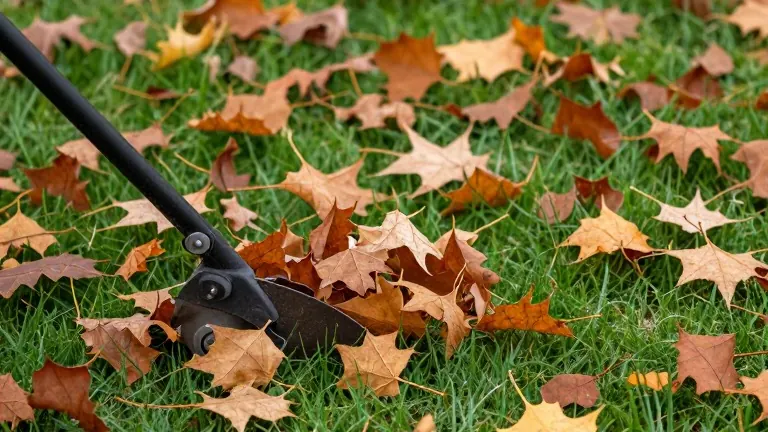
Dan Sharp, a master arborist with the Davey Tree Expert Company, recommends mowing leaves rather than raking them into large piles.
Mowing breaks the leaves into smaller particles that decompose faster and allow nutrients to reach the soil more directly under the grass.
Homeowners can rake the mulched particles into garden beds for extra winter protection, but whole leaves should be avoided if they appear unsightly or blow around easily outside urban areas where natural decomposition occurs in forests. The exception to the leave-it-alone rule involves trees affected by foliar diseases. Arborists reported a rise in tar-spot disease on Norway maples earlier in the year, a fungal condition that can cause early leaf loss in July or August. Powdery mildew, which appears as white dusty spots on leaves, presents a similar risk. Sharp explains that when diseased leaves fall, the pathogen enters the soil and can reinfect new leaves in the spring. In these cases, raking and bagging the leaves helps limit the spread of the disease. Trees are more susceptible to these infections during dry summers if they lack adequate water or are planted in poor quality soil. Property owners looking to plant new trees in the fall should consider species that offer vibrant colors and resist pests. Sweetgum trees display red, yellow, and orange hues in the fall and are a recommended choice. Sharp advises avoiding boxwood shrubs due to invasive pests like the box tree moth, which can defoliate plants quickly and spawn multiple generations per year. Boxwood leafminer and psyllid also cause stunted growth. Yew shrubs offer an alternative with red berries that appear in the fall, though these berries are poisonous and should be pruned or kept away from children. Euonymus, dogwood, and viburnum are suitable options for garden edging. To protect daffodil and tulip bulbs from squirrels, applying six to eight inches of mulch in the garden during the fall is an effective measure.
Source: Burlington Post