Halley's Comet Debris Creates Rare Meteor Display Over Georgia
Astrophotographer Tim McCollum captured three Orionid meteors near Betelgeuse on Oct. 21 as the annual shower approaches its peak activity.
By Emmanuel Obasi ·
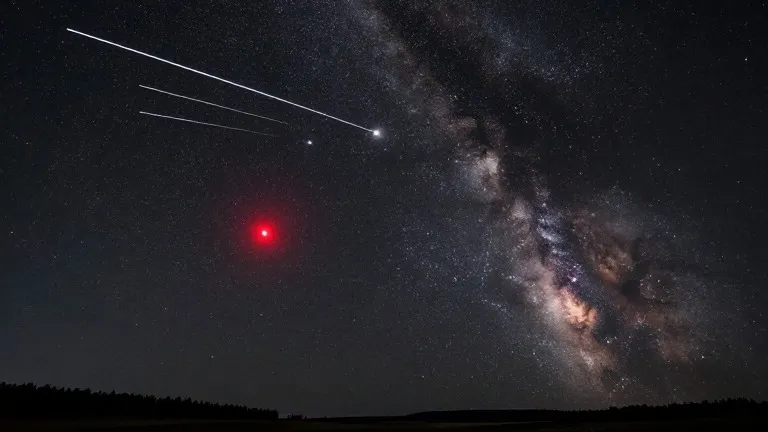
Three meteors from Halley's Comet streaked across the sky above Toccoa, Georgia, between 3 a.m. and 4 a.m. on Oct. 21. The event occurred during the annual Orionid meteor shower, which is currently building toward its peak intensity.
The glowing trails were produced by debris shed by Comet 1P/Halley. Although the comet is located more than 3 billion miles from Earth, the particles it left behind continue to enter the atmosphere and burn up as meteors. Each of the three captured objects appeared to radiate outward from a specific point in the constellation Orion.
Tim McCollum, an astrophotographer, recorded the activity using a Canon EOS Ra camera paired with an RF 28-70 f2.0 lens. He utilized a star tracker to maintain alignment with the radiant point, which lies near the red giant star Betelgeuse. McCollum took multiple 30-second exposures and merged them into a single composite image using PixInsight software.
The final photograph includes several deep sky objects alongside the meteor trails. The stars of Orion's Belt appear on the right side of the frame, positioned close to the glow of the Orion Nebula. This nebula is one of the nearest major star-forming regions to Earth. The Rosette Nebula, designated as Caldwell 49, is also visible within the dense starfield and dust lanes of the Milky Way's galactic plane.
The Orionid meteor shower remains active until Nov. 7. Observers in the coming nights will have further opportunities to spot meteors originating from Halley's Comet debris. The display offers a visual link to a celestial body that is currently distant from the solar system.
A secondary phenomenon may also be visible during this period. Earth is passing through debris streams left by Comet 2P/Encke, which generate the Taurid meteor shower. This specific stream has the potential to produce occasional large fireballs, adding another layer of activity for skywatchers.
McCollum's image serves as a record of the shower's current state. The combination of meteor trails and known deep sky objects provides a detailed snapshot of the autumn night sky. The activity level is expected to increase as the shower moves closer to its maximum rate.
Source: Space.com