Boise State Automates Observatory Dome With $120,000 in Private Funds
A new robotic system allows student researchers to track exoplanets while expanding public access to the campus stargazing deck.
By Emmanuel Obasi ·
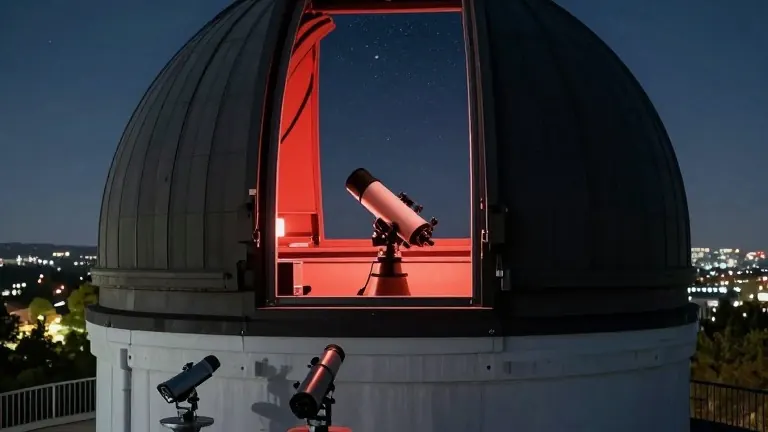
The Boise State University observatory dome became fully automated in late July after a $120,000 fundraising effort concluded. The renovation allows a robotic mount to track celestial objects while the top of the dome rotates independently to follow the target. This upgrade enables student researchers to collect data on exoplanets with minimal manual intervention.
Brian Jackson, an astronomy professor who joined the university in 2014, initiated the modernization process. He noted that the facility previously lacked computerized controls, limiting its research capacity. In 2016, he led a $60,000 campaign to purchase a robotic mount that could track objects as they moved across the sky. The dome, however, remained manual until the recent project.
The department launched the second fundraising campaign in 2024. Jackson stated that the vast majority of the $120,000 came from private donors and community members. He described the community support as gratifying, noting that the facility has served as a stargazing hub since 1977. The renovation also reinforced the observatory deck, allowing for more visitors to use smaller telescopes.
Undergraduate students are now using the automated system for specific research projects. Anna Humphrey, a fourth-year astrophysics student, helped troubleshoot the equipment. She participates in a Vertically Integrated Projects course that collaborates with the international Short-Period Planets Group. The students study exoplanets that orbit very close to their host stars in periods of less than one day.
The team investigates whether tidal decay gradually shrinks the orbits of these planets. Lucas Combs, a fourth-year student, explained that the goal is to prove that this decay exists and potentially leads to collisions between planets and their stars. To find evidence, students observe transits, moments when a planet passes in front of its star. They record the dimming of starlight to create light curves and measure orbital timing.
Students use small Unistellar telescopes on the deck to collect observations over several hours. They then process the data in a lab in the Multipurpose Building. Combs said the experience prepares students for graduate school and allows them to contribute to national research efforts. Emily Sjostrom, a third-year student, said the work helped her understand what a career in research might look like.
The department also maintains the First Friday Astronomy program, which is in its tenth year. This month-long series features astronomers, policy experts, and journalists. The program is almost entirely donor-funded. On November 6, the department will host Barbara Cohen, an Artemis III project scientist at NASA Goddard Space Flight Center. She will discuss the science behind the mission to return astronauts to the moon. The event includes a lecture and stargazing if the skies are clear.
Jackson noted that the community has supported the program for decades because the experience of looking through a telescope is immediate. He said that seeing the moons of Saturn or the bands of Jupiter through a large telescope makes the distance of space feel smaller. The facility remains open to the public for stargazing events.