Naked-Eye Viewing: Moon, Mars, and Jupiter to Share the Sky
The three bodies will appear close together in the night sky later this month, an event viewers can watch without equipment.
By Thabo Hoffmann ·
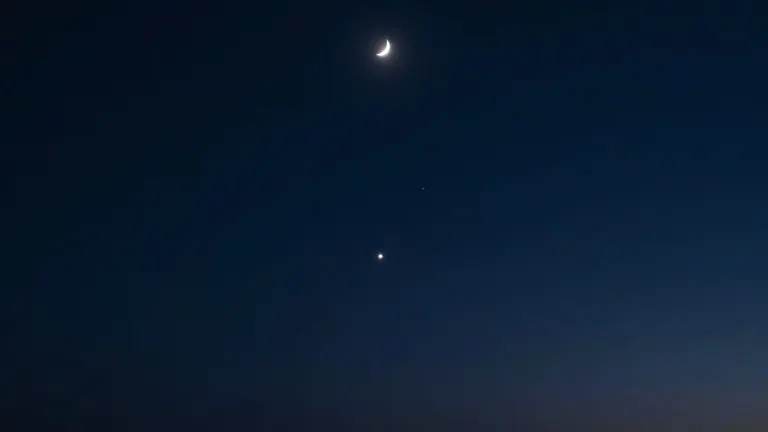
The night sky will offer a visible grouping of three familiar bodies later this month, an alignment that requires no telescope to observe. On November 23, the Moon will pass near Mars and Jupiter, according to the schedule published by Cascade PBS.
The arrangement places three objects in the same region of sky on a single date. Mars and Jupiter, both planets visible to the naked eye, will sit close to the Moon at the time of viewing. The three appear near one another from a ground observer's perspective; they are not physically close in space. The Moon orbits Earth, while Mars and Jupiter orbit the Sun at distances measured in millions and hundreds of millions of kilometers.
The November 23 date falls four weeks from the article's publication on October 28, 2026. Viewing requires clear skies and a sightline above the horizon. No special equipment is needed to see the three bodies together.
The listing sits among a long record of sky events that Star Gazers has documented. The program's archive includes a June 2015 segment titled "See a Moon-Star-Planet Sandwich" covering June 15 through 21 of that year, and an October 2014 segment on planets at dusk and dawn running October 27 through November 2. The archive also holds an October 2014 item on upcoming solar eclipse viewing for October 13 through 19.
Trace Dominguez hosts Star Gazers. The program's video catalog covers a range of topics, including the Andromeda galaxy, the physics of shooting stars, the engineering of NASA's largest telescope, the five types of nebulae, aurora borealis viewing in autumn, lunar weather, and the status of Pluto as a planet.
Mars and Jupiter remain visible to the unaided eye under ordinary viewing conditions. The Moon, in its cycle, moves through the region of sky where the two planets appear, which is how the three can be seen together on a given date. The November 23 grouping is listed on the Cascade PBS schedule.
Source: Cascade PBS