Autonomous Vehicle Lighting: Federal Regulators Propose Cyan Markers
The NHTSA suggests a national standard for blue-green lights to identify driverless cars, aiming to replace the current patchwork of industry signals.
By Thabo Hoffmann ·
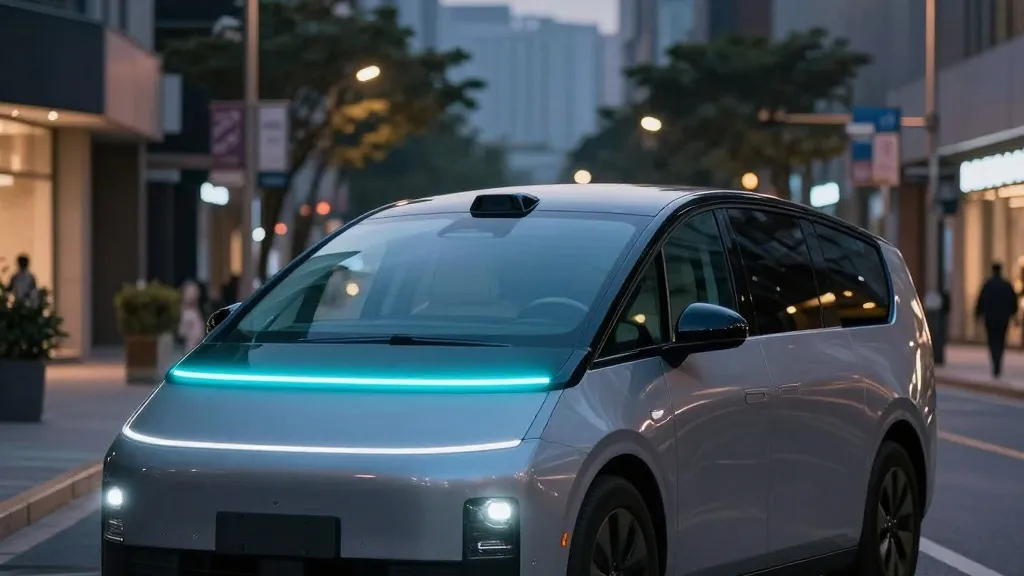
A single color, cyan, is now at the center of a federal effort to solve one of the most persistent challenges in the autonomous vehicle industry: how a car without a human driver signals its status to the world. The National Highway Traffic Safety Administration (NHTSA) has released proposed amendments to Federal Motor Vehicle Safety Standard No. 108. This rule governs vehicle lighting and would establish a unified visual language for robotaxis and self-driving shuttles.
The proposal seeks to balance two competing interests. First, it aims to reduce the regulatory burden on manufacturers designing vehicles without human operators. Second, it attempts to standardize how these vehicles communicate with pedestrians, cyclists, and other drivers. Currently, the industry operates without a single national rule, leading to varied and sometimes confusing signals on the road.
NHTSA argues that cyan is the only viable option because other colors are already assigned specific functions. Red, amber, and white lights are standard for braking, signaling, and illumination, while flashing blue or red lights are reserved for emergency services. The agency states that the cyan marker lamps would clearly and consistently signal to law enforcement and other road users when an automated driving system is operating the vehicle. This choice theoretically fills a visual gap without introducing new confusion into traffic patterns.
There is some precedent for this approach, though it has not been without changes. Mercedes-Benz previously secured state-level approval for turquoise lights on its Level 3 Drive Pilot vehicles. However, the automaker has since abandoned that specific approach in favor of a Level 2++ system. Despite this shift, NHTSA is pushing for a national standard that major players like Waymo, Nuro, Zoox, GM, and Mercedes could all adopt in a uniform manner.
Under the new rules, the installation of cyan lights would remain optional for manufacturers. However, if a company chooses to include them, it must adhere to federal requirements regarding color, brightness, and placement. This move is designed to prevent a fragmented market where different companies use different colors or signal patterns, ensuring that any driver or pedestrian can recognize the light from any make of self-driving car.
The proposal also addresses internal vehicle controls that are becoming obsolete in driverless designs. NHTSA proposes to eliminate requirements for physical hazard switches, manual beam shifters, and turn levers, which are unnecessary when a human is not at the wheel. The agency also plans to update the 12.8-volt testing standard to accommodate modern LED systems, removing administrative hurdles for manufacturers. Additionally, NHTSA is considering dropping rules that dictate whether high-beam lights must be positioned above or below low-beam lights.
These changes align with a broader Department of Transportation initiative to accelerate the deployment of autonomous vehicles. The goal is to make it easier for automakers to build cars without traditional human-centric controls, such as steering wheels and pedals. By simplifying the regulatory landscape, the government hopes to facilitate the transition to a more automated transportation network.
Despite the forward-looking proposal, regulators are still enforcing current rules as they are written. Last month, NHTSA opened an audit query into the Tesla Cybercab to examine the technical data Tesla relied on for its certification. The primary concern is the absence of design features currently required by federal standards, including sideview mirrors, pedals, and a steering wheel. This action highlights the tension between existing regulations and the rapid evolution of self-driving technology.
Source: The Verge