South Dakota Aquifers Face Depletion
Falling water levels in underground sources threaten residential and agricultural supply as population growth outpaces recharge rates.
By Thabo Hoffmann ·
South Dakota’s underground water reserves are shrinking as drought conditions persist and population growth accelerates. The state’s aquifers, which supply drinking water and irrigation, are showing signs of strain that scientists say could limit future development. Jay Gilbertson, manager of the East Dakota Water Development District, warned that if current trends continue, the state will reach a saturation point. He stated that the next family or business moving to South Dakota may need to bring their own water.
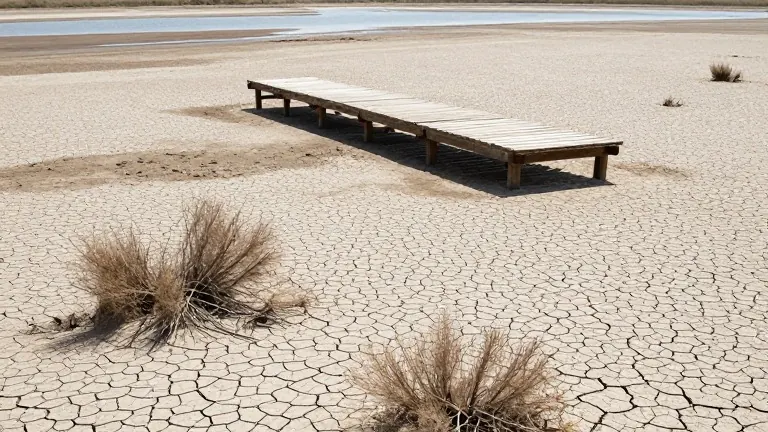
The visual evidence of this decline is stark at Bear Butte State Park near Sturgis. The park’s central lake, typically a 215-acre body of water 15 feet deep, has nearly vanished. Only a narrow strip of surface water remains, with depths measured in inches. The popular fishing pier now stands on hundreds of yards of exposed, dried lakebed. Jeremy Kientz, a fisheries supervisor for the South Dakota Game Fish and Parks Department, identified low precipitation as the primary driver for the lake’s depletion. He noted that the lake relies on rainfall rather than springs or creeks.
Beyond the Black Hills, water drawdowns are visible at Angostura, Bell Fourche, and Pactola reservoirs. Spring Creek, a waterway that has flowed for generations through the central Black Hills, has run dry in several sections. In western South Dakota, rural ranches and homesteads report wells running low or dry. In the east, rural water systems are unable to accept new customers because the aquifers they tap are fully committed by existing water rights contracts. The Big Sioux Aquifer, which serves communities including Sioux Falls, is also experiencing shortages.
Data from the U.S. Geological Survey shows a sharp increase in water extraction. In 1960, fewer than a dozen municipal wells in four major Black Hills counties drew from local aquifers. That number has risen to nearly 100. Mark Anderson, an adjunct geology professor at South Dakota Mines, pointed to USGS observation wells in the Rapid City area that reveal a steady decline in water levels. He cautioned that another year of drought like the current one would create significant concerns for the state’s water security.
New industrial projects are adding pressure to these systems. Powertech USA, a subsidiary of enCore Energy, proposed the Dewey-Burdock uranium mining project northwest of Edgemont. The plan involves in-situ mining on more than 12,000 acres. The company filed applications to drill 1,000 wells into the Inyan Kara aquifer to remove nearly 2.4 billion gallons of water annually. It also proposed two wells into the Madison aquifer to remove about 83 million gallons per year. Federal permit approvals were obtained earlier this year after legal challenges delayed the project for nearly 15 years.
Public comment on the uranium project is open until November 9. A hearing before the South Dakota Water Management Board is scheduled for December 2. The chief engineer of the water rights program has recommended approval for both proposals. The company plans to restore the aquifers by circulating clean water through the wells until quality returns to near-pre-existing conditions.
State lawmakers are responding to the crisis. State Sen. Helene Duhamel, a Rapid City Republican, leads efforts to secure new water sources. She highlighted a proposal to build a Missouri River pipeline to the Black Hills region. At a late October meeting in Sioux Falls, representatives of rural water systems discussed expansion projects that could total $13 billion over the next few decades. State Rep. Mike Derby, a Rapid City Republican, co-chairs a legislative work group focused on water development. He described the situation as a wake-up call for his colleagues in the Joint Appropriations Committee.
More Business · Consumer Watch · Report a business · Got a Story?