Crows Outpace Primates in Complex Decision Speed
New research reveals that crows utilize the same mathematical logic as monkeys for decision-making, but they process visual evidence at twice the speed.
By Thabo Hoffmann ·
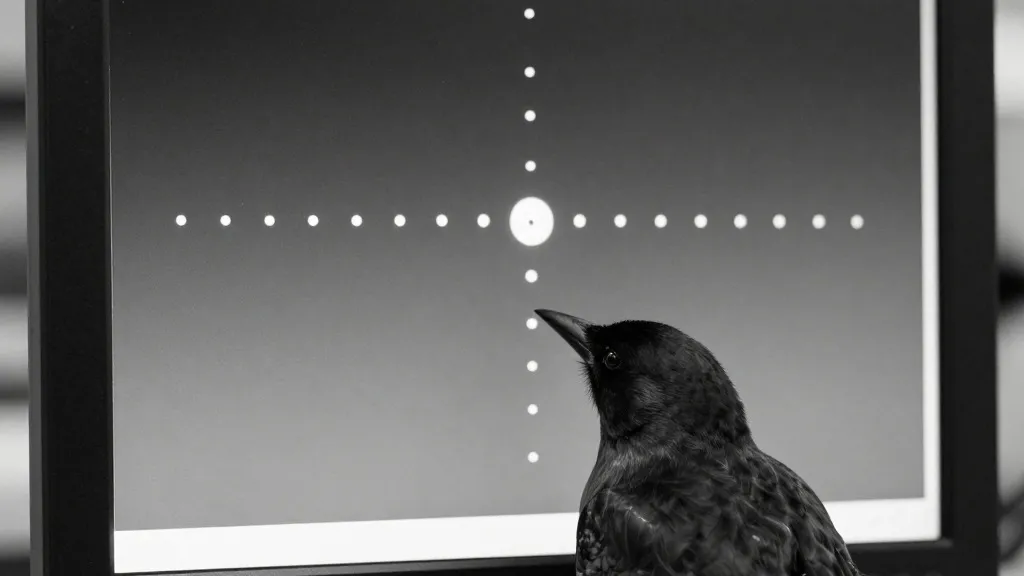
Crows solve complex visual puzzles with the same logical precision as primates, yet they reach a conclusion in half the time.
For decades, scientists have relied on experiments with monkeys to understand how brains process information and make choices. The standard test, known as the random-dot-motion task, involves a cloud of flickering specks that drifts weakly in a specific direction. In primates, this task demonstrated that neurons in the neocortex accumulate visual evidence over time. Their firing rates increase until they cross a threshold, at which point the animal commits to a specific choice. Because birds lack a neocortex, researchers had long wondered how their differently organized brains handled similar cognitive demands.
Andreas Nieder, a neurobiologist at the University of Tübingen, identified this gap as a critical question for the field. He noted that understanding how an avian brain encodes decisions was a major unknown. To address this, Nieder and his colleague Philipp Schmidbauer designed a study to compare the two groups directly. They selected two hand-raised carrion crows to participate in the experiment. The setup was carefully constructed to mirror the existing monkey protocols as closely as possible.
The crows were positioned in front of a touch-sensitive monitor that displayed white dots against a black background. A portion of these dots would drift together in one of four directions: left, right, up, or down. The birds indicated their perception by pecking at one of the targets located beside the display. A correct selection was rewarded with a mealworm. Nieder emphasized that the team intentionally kept the task identical to the monkey version. The only mechanical difference was that the crows used pecks to signal their decisions, whereas monkeys indicated their choices through eye movements.
The researchers adjusted the difficulty of the task by altering the percentage of dots that moved coherently. At the easiest level, 81 percent of the dots moved together, making the direction trivial to identify. At the hardest level, only 3 percent moved in unison, a pattern barely distinguishable from random noise. The team also included a condition where zero percent of the dots moved coherently, meaning there was no correct answer to detect.
The results confirmed that the crows solved the task using the same mathematical logic observed in primates. Despite the significant structural differences in their brains, the birds followed the same decision-making process. More notably, the crows completed the task twice as fast as the monkeys. This finding suggests that a brain without a neocortex can arrive at complex decisions through a comparable and efficient process.
This study offers a new perspective on the efficiency of avian cognition. It highlights that different neural architectures can achieve similar outcomes, sometimes with greater speed. The research underscores that the absence of a specific brain structure does not necessarily limit cognitive capability. Instead, it may lead to alternative pathways for processing information that are just as robust, if not more rapid, than those found in primates.
Source: Ars Technica