Budget Intel Board Delivers Style
A new white motherboard packs high-end features into a compact form factor for under two hundred dollars.
By Thabo Hoffmann ·
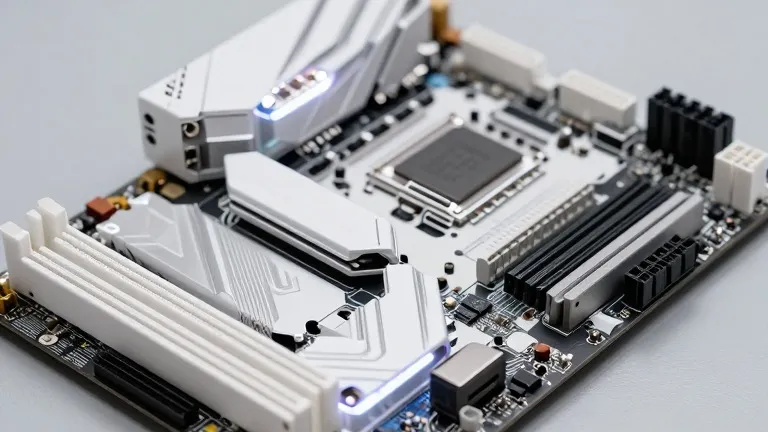
Gigabyte has released the Z890M Aorus Elite WiFi7 Ice, a Micro ATX board priced at $209 that targets builders seeking a sleek white aesthetic without the high cost of premium ATX models. The device landed on the test bench this week and immediately drew attention for its visual appeal. Reviewers note that its design is a standout feature, making it one of the better looking options for anyone planning a monochromatic system build.
The hardware is tuned for Intel Core Ultra 200S Plus processors. It pairs best with Micro ATX cases. Storage options include three M.2 sockets and four SATA ports. Networking is handled by 2.5 GbE and Wi-Fi 7. The wireless chip is limited to 160 MHz channels. Audio uses a Realtek ALC897 codec. This basic solution is fine for most users. It may fall short for audiophiles or music producers.
Heatsink coverage is a major strength. Many rivals in this budget class skip full coverage on the lower half. This model includes it. A large heatsink covers the primary M.2 socket. Two RGB lighting zones add glow. One sits near the VRMs. The other is under the chipset heatsink. Fans are well served too. Six 4-pin headers deliver up to 2A or 24W each.
Connectivity is robust for the price. The primary M.2 socket connects through the CPU at PCIe 5.0 x4 speeds. The other two connect through the chipset at PCIe 4.0 x4. One accepts modules up to 110mm. RAID0/1/5/10 is supported for NVMe drives. The board has two full-length PCIe slots. The main slot runs at PCIe 5.0 x16. The second runs at up to PCIe 4.0 x4. A large graphics card may block the second slot.
Power delivery is capable but not robust. The board has 15 phases. Twelve are for Vcore. Dual 8-pin EPS connectors feed the system. 60A DrMOS parts provide 720A in total. This is enough for the Core Ultra 7 270K Plus. It also supports the Core Ultra 5 250K Plus. Even the Core Ultra 9 285K is covered. Reviewers advise keeping air moving through the case. They suggest caution with heavy overclocking on the 285K or 270K Plus.
Memory support lists up to DDR5-9200. In testing, the fastest kit rated DDR5-8800 did not work properly. A DDR5-8200 kit ran fine. The reviewer recommends sticking to the memory QVL for best results. The rear I/O is sparse next to high-end boards. It provides nine USB ports in total. Four are USB 2.0. Four are USB 3.2 Gen 1. One is USB 3.2 Gen 2 Type-A. The only Type-C port is USB4 at 40 Gbps. It includes DisplayPort output. A DisplayPort 2.1 output sits alongside it. A front-panel HDMI output is also available.
Performance is average overall. It does well in some tests. It is slightly below average in others. It performed well in 3DMark. It also performed well in real games. Gamers have little to worry about. The board supports AI Perfdrive. This offers customizable BIOS presets. One-click CPU improvements are possible. The box contents are sparse but typical for the price. Two white SATA cables are included. A rubber pad is there. An extra M.2 thermal pad is included. An EZ connector for the front panel is present. An installation guide is provided. Tool-free touches like EZ-Latch and EZ-Click M.2 mounting round out the package. The review lists the EZ features among the board's strengths.
Source: Tom's Hardware