Averted Temple Attack Spots Anti-Indian Hate
A college student in Illinois allegedly planned to attack a Hindu temple, a plot experts link to a sharp rise in online rhetoric targeting South Asian Americans.
By Thabo Hoffmann ·
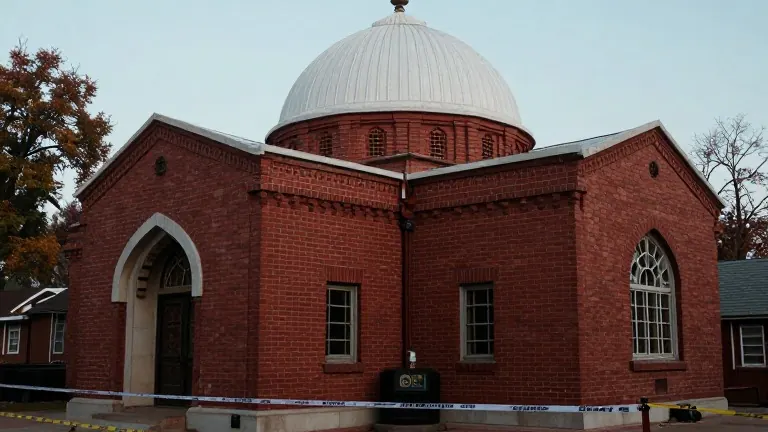
Alexandros Paporakis, 19, walked into the Sri Venkateswara Swami Temple in Aurora, Illinois, on October 11 with an AR-style rifle and 300 rounds of ammunition. He intended to carry out a mass shooting during a major Hindu nine-day festival. Police said a jammed gun prevented the attack from unfolding as planned.
Palatine police charged the college student and Taco Bell cashier with making a terrorist threat and unlawful possession of a rifle. An affidavit filed by a Cook County assistant state attorney revealed that Paporakis had written an eight-page document outlining his motivation. The text contained derogatory and racially charged slurs directed at people of Indian ancestry, Jews, and African Americans, describing them as subhumans.
Officers found a bag in Paporakis' apartment containing eight loaded magazines, one loaded extended magazine, and body armor. The space also held a gas can and items bearing Nazi symbols and anti-Indian slurs. Court filings indicate he had been planning an attack for two years and selected the temple location two months prior to the incident.
Rohit Chopra, a professor of communications at Santa Clara University, stated that an event of this scale had not previously been directed at South Asians. He noted that the community has historically been viewed as a model minority, but online discourse has shifted over the last four years. Prasiddha Sudhakar, a board member of the Network Contagion Research Institute, added that toxic rhetoric has moved from fringe platforms to mainstream social media.
Sudhakar identified a baseless conspiracy theory known as the Brahmin Organized Government as a key driver of the hate. The narrative mirrors the Zionist Organized Government theory, positing that a cabal of Indian elites controls the government to displace native workers. This online vitriol has intensified with the political visibility of Indian Americans, including Usha Vance and Vivek Ramaswamy.
Research co-authored for the Center for the Study of Organized Hate found that anti-South Asian hate speech on the platform X was 240% higher between January 2025 and June 2026 than it was in January 2024. Chopra attributed this spike to political debates over H-1B visas, a category where Indian nationals account for more than 70% of recipients.
Congressman Raja Krishnamoorthi, who was at the temple with his family on October 11, has called for the FBI to investigate the incident as a federal hate crime. Pushpita Prasad of the Coalition of Hindus of North America explained that the community faces unique organizational challenges because many Hindus do not belong to formal congregations. According to Pew Research Center data, two-thirds of the Indian population in the U.S. are immigrants, and nearly half of those are not naturalized citizens.